
How to Choose Technology That Grows With You
There are two ways for a growing SMB to get technology wrong, and they sit at opposite ends of the same mistake.
The first is under-investing: sticking with tools and processes that were fine at 10 people but are visibly straining at 40, because nobody wants to spend money “fixing something that isn’t broken yet.” The second is over-investing: buying the enterprise platform, the elaborate infrastructure, the tool built for a company ten times your size — because it looks like the serious, grown-up choice, even though you won’t need most of what it does for years.
Both mistakes come from the same place: choosing technology based on where the business is right now, without a clear view of where it’s actually heading. Getting this right isn’t about picking the fanciest option or the cheapest one. It’s about matching the tool to the trajectory.
Why “it works for now” isn’t the right test
When you’re evaluating a new system, tool, or platform, the obvious question is: does this solve my current problem? That’s necessary, but it’s not sufficient. The better question is: does this still make sense if we’re twice the size in 18 months? Does it still make sense if we’re a tenth of the size, because a big contract fell through?
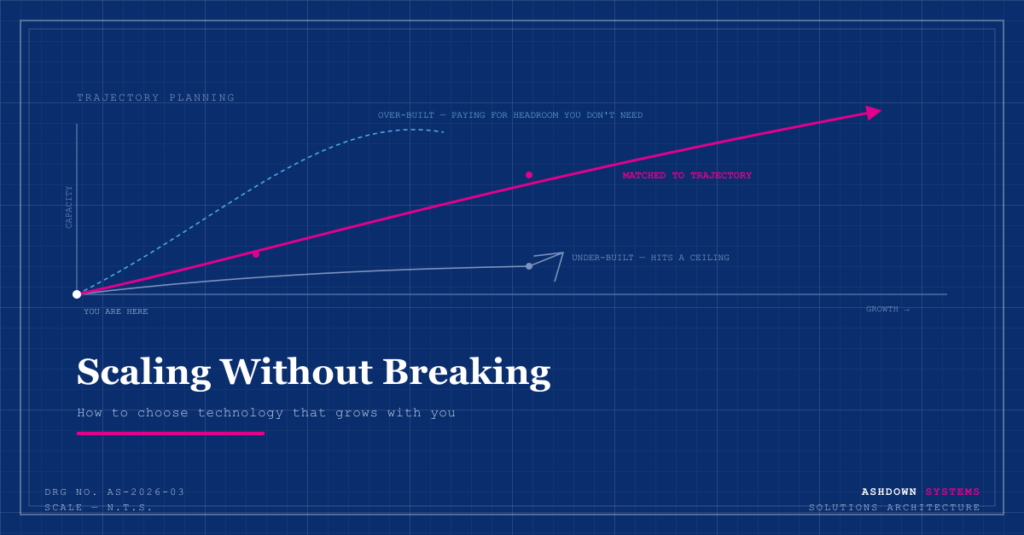
Technology decisions made purely for today tend to break in one of two predictable ways as a business grows:
- They hit a hard ceiling.
- The tool simply can’t handle more volume, more users, or more complexity — and migrating off it mid-growth is far more disruptive than choosing better the first time.
- They become quietly expensive.
- Some tools scale in cost far faster than they scale in value. What was a reasonable monthly fee at 5 users becomes a serious line item at 50, for a tool that hasn’t actually gotten any more useful.
Neither failure mode is obvious when you’re making the initial decision — which is exactly why it’s worth having someone think it through properly rather than just picking what’s fastest to set up.
What “grows with you” actually means
This isn’t about always buying the most scalable, most powerful option available. That’s the over-investment trap — paying for headroom you’ll never use, and often taking on complexity you don’t need yet either. A tool that’s overkill for your current size can slow a small team down just as much as a tool that’s too limited.
What you’re actually looking for is a good match between:
- Where you are now
- Team size, transaction volume, complexity of what you’re managing
- Where you’re realistically heading
- Not a best-case fantasy, but a grounded view of growth over the next 1–3 years
- How painful it would be to switch later
- Some tools are easy to move away from if you outgrow them; others lock in your data, your workflows, or your team’s habits in ways that make switching a genuine project
A tool that’s slightly ahead of your current needs, but not wildly so, and that doesn’t trap you if your plans change — that’s usually the right zone. It’s rarely the newest or shiniest option. It’s the one that fits the shape of your actual growth curve.
The role of architecture in getting this right
This is where Solutions Architecture earns its keep. It’s not about recommending specific products — a good architect isn’t loyal to any particular vendor. It’s about building a clear picture of how your systems fit together today, and how that picture needs to change as the business grows, so that every new tool gets evaluated against an actual plan rather than gut feel or a sales pitch.
In practice that looks like:
- Mapping out what’s likely to break first as you scale
- Often it’s not the tool you’d expect
- Setting some ground rules for new tools before you need them
- What they must integrate with, what data they must not silo, what happens if you need to replace them in two years
- Separating “must solve this now” from “nice to have eventually,”
- So that you’re not paying today for capability you won’t touch for 18 months
- Building in the flexibility to swap out individual pieces later
- Without having to rebuild everything around them
Done well, this means growth doesn’t feel like a series of emergencies. It feels like the systems were expecting it.
Growth reveals what you built
Every growing business eventually finds out what its systems are really made of. Slow, steady growth is forgiving — it gives you time to notice and fix small cracks. Fast growth is not; it finds every weak point at once, usually at the worst possible moment, like a big new client or a busy season.
The businesses that scale smoothly aren’t the ones who guessed right about every tool. They’re the ones who built with the next stage in mind from the start — so that growth becomes a matter of switching things on, not tearing things down and starting over.
Ashdown Systems helps UK startups and SMBs choose and design technology that’s built for where the business is heading, not just where it is today. If any of this sounds familiar, get in touch.