

How to Spot Them
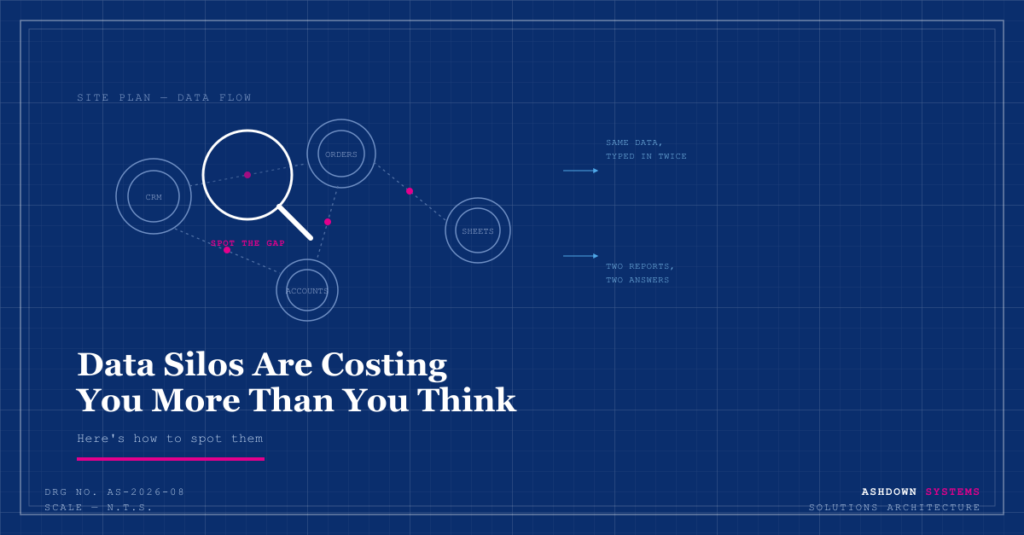
Ask most business owners if they have a “data silo problem” and they’ll say no. Ask them if two different systems ever disagree about a customer’s order history, or if someone spends part of their week copying numbers from one place to another, and the answer is usually yes. That gap — between not recognising the term and living with the symptom every week — is exactly why data silos are one of the most under-diagnosed costs in a growing SMB.
A data silo isn’t a technical failure. It’s just information that’s trapped in one system, unable to flow to the other systems that need it, without someone manually moving it there. Every business ends up with a few. The question is whether you know where yours are, and what they’re actually costing you.
Why silos form even when nobody makes a mistake
Data silos aren’t usually the result of poor planning. They’re the natural outcome of a business growing normally:
- Each department picks the tool that solves its problem, with no requirement to consider how it connects to anything else.
- Tools get adopted at different times, by different people, for different reasons — nobody’s coordinating the full picture.
- What starts as “we’ll just export this to a spreadsheet for now” becomes a permanent, invisible process.
- Systems that could integrate never do, because nobody had the time, or the budget, to set it up properly at the time.
Every one of those decisions made sense on its own. The silo is what happens when you add them all together and nobody goes back to look at the sum.
Six signs you have a data silo problem
Data silos rarely announce themselves. They show up as small, recurring frustrations that get accepted as “just how things are.” Some of the clearest signs:
- The same information gets typed in more than once.
- A customer’s details entered into the CRM, then re-entered into the invoicing system, then again into a delivery or fulfilment tool. Each entry is a chance for a typo, and a chunk of someone’s time that shouldn’t be necessary.
- Two reports never quite agree.
- Finance has one number for monthly revenue, sales has a slightly different one, and nobody can say with confidence which is right — because they’re pulling from different, disconnected sources of truth
- There’s a “master spreadsheet” holding the business together.
- Somewhere, there’s a spreadsheet someone maintains by hand, stitching together data that should be flowing automatically between systems. It works, but everyone quietly knows it’s fragile.
- Answering a simple question takes several people and several systems.
- “How many active customers do we have?” should be a five-second lookup. If it actually requires pinging three people and cross-referencing two tools, that’s a silo, not a minor inconvenience.
- New starters take weeks to understand “how things really work.”
- If onboarding involves a lot of “oh, and you also have to check this other system for that,” the knowledge of how data actually connects is living in people’s heads, not in the systems themselves.
- Decisions get delayed because nobody trusts the numbers.
- This is the most expensive sign. When leadership hesitates on a call because the data feels unreliable, that’s not caution — that’s the silo problem actively slowing the business down.
If two or three of these sound familiar, you almost certainly have silos costing you more than you’d guess.
What silos actually cost
The individual symptoms look small — a few minutes here, a slightly awkward report there. Added up across a team, over a year, the costs are rarely small:
- Time.
- Manual re-entry and reconciliation is a real, recurring cost, even though it never shows up as a distinct line item anywhere.
- Accuracy.
- Every manual handoff between systems is a chance for data to drift or drop out entirely, and those errors tend to surface at the worst moments — a customer complaint, a failed audit, a board question nobody can answer cleanly.
- Speed of decision-making.
- Businesses with connected data can answer questions in minutes. Businesses with siloed data spend that time reconciling first, and often decide with worse information anyway.
- Growth capacity.
- Manual processes that just about work with a small team become genuinely unworkable as volume grows — right when you can least afford the disruption of fixing them.
Spotting silos is the easy part
The signs above are usually visible to anyone paying attention — the harder part is knowing what to actually do once you’ve spotted them. Not every silo needs the same fix; some just need a better integration between two existing tools, others point to a genuine gap in how the business’s data is structured, and a few aren’t worth fixing at all relative to their actual cost.
That prioritisation — which silos are quietly expensive and which are minor — is where an outside architectural view helps most. It turns a list of everyday frustrations into a clear, ranked plan: what to connect first, what to leave alone, and what a properly designed flow of data should actually look like for a business your size.
Ashdown Systems helps UK startups and SMBs find and fix the data silos that are quietly costing them time, accuracy, and growth. If any of this sounds familiar, get in touch.