

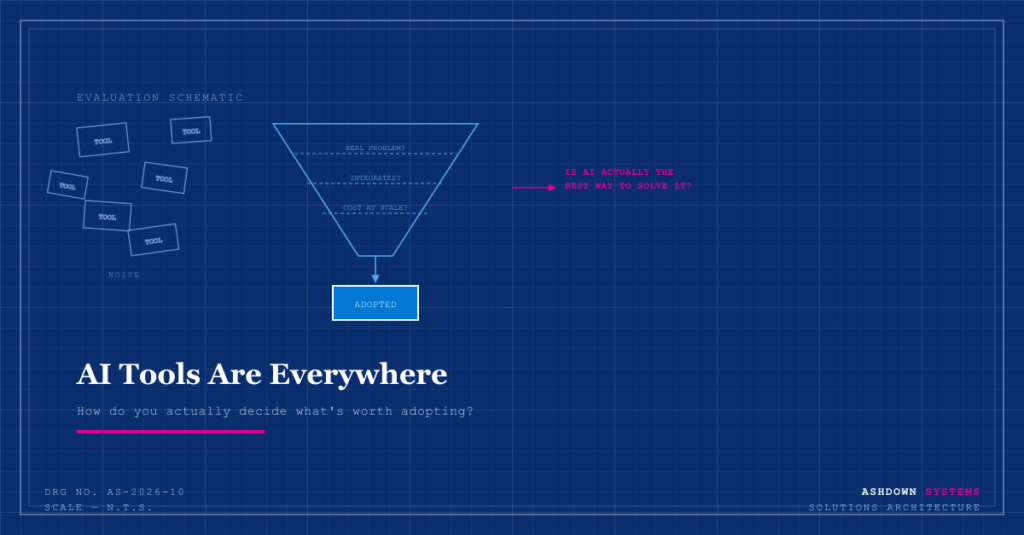
Every business, at this point, is being pitched AI. New tools launch weekly, existing software adds an “AI-powered” feature to its marketing, and it’s genuinely hard to tell which of it is worth your attention and which is noise. For a lot of SMBs, the result is a kind of stuck feeling: aware that AI probably matters, unsure what to actually do about it, and wary of either falling behind or wasting money chasing hype.
The good news is that deciding what’s worth adopting doesn’t actually require becoming an AI expert. It requires treating it like any other architecture decision — because that’s exactly what it is.
Why this feels harder than it should
Most technology adoption decisions have a fairly clear shape: there’s a specific problem, a shortlist of tools that solve it, and a reasonably stable set of options to compare. AI adoption right now doesn’t have that shape:
- The pace of change makes “best in class” a moving target.
- A tool that’s clearly leading today may be matched or overtaken within months, which makes normal due diligence feel less reliable.
- A tool that’s clearly leading today may be matched or overtaken within months, which makes normal due diligence feel less reliable.
- The marketing is louder than the substance.
- “AI-powered” gets attached to features that are genuinely useful and features that are barely more than a chatbot bolted onto an existing product, and it’s not always obvious which is which from the outside.
- “AI-powered” gets attached to features that are genuinely useful and features that are barely more than a chatbot bolted onto an existing product, and it’s not always obvious which is which from the outside.
- The fear of missing out is doing a lot of the decision-making.
- A real, if often quiet, anxiety that competitors are pulling ahead pushes businesses toward adopting tools quickly, without the normal scrutiny they’d apply to any other significant purchase.
- A real, if often quiet, anxiety that competitors are pulling ahead pushes businesses toward adopting tools quickly, without the normal scrutiny they’d apply to any other significant purchase.
- It touches everything at once.
- Unlike a single-purpose tool, AI capability can plausibly show up in customer service, marketing, operations, and product all at the same time — which makes it hard to know where to even start evaluating.
None of this means AI adoption should be treated differently from other technology decisions. If anything, it means the normal discipline matters more, not less, precisely because the noise is louder.
The question that cuts through the noise
Strip away the hype, and the evaluation question is the same one that applies to any tool:
“What specific problem does this solve, and is AI actually the best way to solve it?“
That second half matters more than it sounds. Plenty of AI tools are solving real problems. Some are solving problems that a simpler, non-AI tool would handle just as well, at lower cost and lower risk. Adopting AI because it’s AI, rather than because it’s the best available solution to a specific problem, is how a lot of wasted spend and abandoned pilots happen.
A practical framework for evaluating AI tools
When a new AI tool crosses your desk — whether someone on your team is pushing for it or a vendor is pitching it — a few questions consistently separate the genuinely useful adoptions from the ones that fizzle out:
- What specific, recurring problem does this solve?
- Not “it could help with X” in the abstract, but a concrete, repeated task that’s currently slow, expensive, or error-prone. Vague potential is a warning sign; a specific bottleneck is a good one.
- Not “it could help with X” in the abstract, but a concrete, repeated task that’s currently slow, expensive, or error-prone. Vague potential is a warning sign; a specific bottleneck is a good one.
- What does it actually integrate with?
- A tool that sits disconnected from your existing systems creates exactly the kind of data silo and manual-reconciliation problem that costs businesses time elsewhere. Integration quality often matters more than the AI capability itself.
- A tool that sits disconnected from your existing systems creates exactly the kind of data silo and manual-reconciliation problem that costs businesses time elsewhere. Integration quality often matters more than the AI capability itself.
- What’s the real cost at the volume you’d actually use it?
- AI tools are frequently priced per-use in ways that scale unpredictably. Understand what the cost looks like at realistic volume, not just the entry-level price you saw in the demo.
- AI tools are frequently priced per-use in ways that scale unpredictably. Understand what the cost looks like at realistic volume, not just the entry-level price you saw in the demo.
- What happens if it’s wrong?
- Every AI tool makes mistakes some percentage of the time. The right question isn’t whether it’s ever wrong, but what the consequence is when it is — and whether there’s a sensible human check in place for anything high-stakes.
- Every AI tool makes mistakes some percentage of the time. The right question isn’t whether it’s ever wrong, but what the consequence is when it is — and whether there’s a sensible human check in place for anything high-stakes.
- Who owns it, and who reviews whether it’s still worth it?
- A pilot that nobody’s responsible for tends to either quietly become permanent infrastructure with no oversight, or quietly get abandoned without anyone noticing. Both outcomes are avoidable with clear ownership from day one.
- A pilot that nobody’s responsible for tends to either quietly become permanent infrastructure with no oversight, or quietly get abandoned without anyone noticing. Both outcomes are avoidable with clear ownership from day one.
- Does this reduce complexity, or add to it?
- A genuinely good AI adoption should make some part of the business simpler to run. If it’s adding another disconnected tool, another login, another system nobody fully understands, that’s a cost worth weighing seriously against the benefit.
Fear of missing out isn’t a strategy
The pressure to “do something with AI” is real, but it’s not a substitute for evaluating a specific tool against a specific problem. Adopting quickly and adopting well aren’t the same thing, and the businesses getting genuine value from AI right now are mostly the ones applying ordinary due diligence, not the ones adopting the most tools the fastest.
Treated properly, an AI tool is just another architectural decision: does it solve a real problem, does it fit with what you already have, and does the cost and risk make sense at your actual scale. Getting that evaluation right, tool by tool, tends to produce a lot more value than trying to have an overarching “AI strategy” before you’ve adopted anything at all.
Ashdown Systems helps UK startups and SMBs cut through the noise and evaluate AI tools against real business problems — not hype. If any of this sounds familiar, get in touch.