

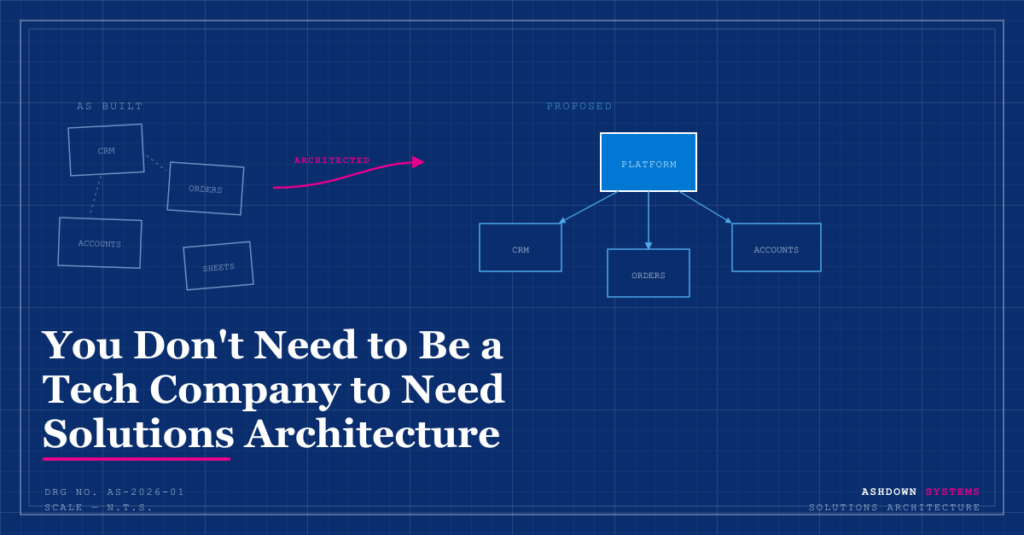
If you run a startup or SMB in the UK, there’s a decent chance you’ve never used the phrase “Solutions Architecture” in a sentence. That’s fine — most business owners haven’t, and most don’t need to. But there’s also a decent chance you’re already living with the exact problem it solves, without having a name for it.
Here’s a scenario that might sound familiar. You started with a handful of tools: an accounting package, a CRM, maybe a booking system or an e-commerce platform. Each one made sense on its own, solved an immediate problem, and got switched on quickly. Eighteen months later, you’ve got data trapped in five different places, someone on your team spends half a day a week manually copying numbers between systems, and nobody’s entirely sure which version of the customer list is the “real” one.
Nothing broke. There was no single bad decision. It just… accumulated. That accumulation is exactly what Solutions Architecture exists to prevent — and to untangle once it’s already happened.
So what actually is it?
Think of it like the difference between building an extension on your house room by room, versus getting an architect to draw up plans first. You can do the former — plenty of people do — and each individual room might be perfectly fine. But without a plan that considers how everything connects (plumbing, load-bearing walls, where the light falls), you end up with awkward compromises baked into the structure, ones that are expensive to fix later because now there’s a wall in the way.
Solutions Architecture is that planning discipline, applied to how a business’s systems, tools, and data fit together. It’s not about writing code. It’s about answering questions like:
- What are we actually trying to achieve, and what does the business need from its systems in 2 years, not just today?
- Which tools should talk to each other, and how?
- Where’s the single source of truth for our customer data, our orders, our finances?
- If we double in size next year, does this setup hold — or does it fall over?
A good Solutions Architect sits above any one piece of software. They’re not selling you a CRM or a cloud platform — they’re figuring out what combination of things (which might include tools you already own) actually serves the business.
Why this matters even if you’re not “technical”
There’s a common assumption that architecture is something for tech companies — SaaS businesses, software vendors, engineering-led startups. It’s true that those companies need it. But arguably, non-technical businesses need it more, precisely because they don’t have anyone in-house whose job it is to spot the problem forming.
A tech company usually has an engineer somewhere who winces when three systems don’t talk to each other. A retail business, a professional services firm, a hospitality group — they often don’t have that person. The disconnect between systems doesn’t show up as a technical error message. It shows up as a Friday afternoon spent reconciling spreadsheets, a customer getting the wrong invoice, or a new hire who takes three weeks to understand “how we actually do things here” because it’s never been written down or built into the systems themselves.
None of that requires you to understand databases or APIs. It requires someone who can look across your whole operation, ask good questions, and design something that fits — then translate it into terms your team can actually use.
What this looks like in practice
For an SMB, Solutions Architecture rarely means a six-month project with a five-figure price tag. More often it looks like:
- A short discovery process to map out what tools you’re using and where the friction actually is
- A clear, plain-English plan for how things should connect — what stays, what goes, what gets automated
- Recommendations that are proportionate to your size, not “enterprise” solutions you’ll grow into eventually
- A roadmap that means the next tool you buy fits into a plan, rather than becoming yet another island
The goal isn’t complexity. It’s often the opposite — removing steps, removing manual work, removing the version-control chaos that builds up quietly over time.
The real cost of not doing this
The businesses that feel this most acutely are usually the ones growing fastest. Every new hire, every new customer, every new system you bolt on either compounds a good foundation or compounds a shaky one. The compounding is the same either way — it’s just a question of which direction it’s working in.
The good news: you don’t need to have a technical team, or even a big budget, to start doing this properly. You just need someone to ask the right questions before the next tool gets bought, not after the third spreadsheet reconciliation of the month.
Ashdown Systems helps UK startups and SMBs design systems and technology that actually fit how their business works — no jargon, no over-engineering. If any of this sounds familiar, get in touch.