
Why Ad-Hoc Tech Decisions Cost SMBs More Later
Every startup and SMB has made this decision at some point: a problem shows up, there’s no time to think it through properly, so someone picks the fastest fix available. A new spreadsheet. A free-tier tool. A quick integration someone found on YouTube. It works. Everyone moves on.
Do that ten times over two years, and you don’t have ten quick fixes. You have a system — just one nobody designed, that nobody fully understands, and that’s now quietly running large parts of your business.
This isn’t a story about bad decisions. Every one of those individual choices was probably the right call in the moment. The problem isn’t the decisions — it’s that nobody ever went back and looked at them together.
Why this happens to good businesses
Ad-hoc tech debt isn’t a symptom of poor management. If anything, it’s a symptom of moving fast, which is exactly what growing SMBs are supposed to do. Nobody sits down and decides to build a fragile, disconnected set of tools on purpose. It happens because:
- Speed beats structure under pressure.
- When a customer needs something now, “good enough” wins over “correct.” That’s usually the right trade-off — the problem is that trade-off is never revisited.
- The person who made the decision moves on.
- The contractor/intern who set up a custom automation left eight months ago. Nobody else knows it exists until it breaks.
- Tools are cheap to add and expensive to remove.
- Signing up for a new SaaS tool takes ten minutes. Untangling it from three other systems, a year later, takes weeks.
- There’s no one whose job it is to see the whole picture.
- Individual team members own individual tools. Nobody owns how they all fit together.
None of this is a failure of judgement. It’s just what happens by default, in the absence of a plan.
What it actually costs
The costs rarely show up as a single dramatic event. They show up as a slow tax on everything the business does:
- Time.
- Someone, somewhere, is manually re-entering data that should flow automatically between systems. Multiply that by every week, every employee doing it, and it adds up to a real chunk of payroll spent on work that shouldn’t exist.
- Errors.
- Manual processes and disconnected systems are where mistakes live — the customer who got billed twice, the order that never made it to fulfilment, the report that quietly used last month’s numbers because nobody noticed the sync had failed.
- Decision quality.
- If your data lives in five places and none of them fully agree with each other, every decision made from that data is built on shaky ground. Leadership ends up making calls based on gut feel because they don’t trust the numbers — even though the business has the numbers, they’re just not usable.
- Growth capacity.
- This is the one that bites hardest. A patched-together system that just about works at 20 staff often doesn’t work at 50. What was a minor inconvenience becomes the thing actively stopping you from scaling — right at the moment scaling matters most.
- Hidden risk.
- Ad-hoc systems tend to have single points of failure nobody’s aware of: one person who knows how the invoicing spreadsheet actually works, one integration that will silently stop functioning if a free API tier gets deprecated. You don’t find out these exist until they fail.
The trap of “we’ll fix it later”
The reason this problem persists is that fixing it never feels urgent — until suddenly it’s very urgent, usually during a growth spurt, a funding round, or a busy season, which is the worst possible time to discover your systems can’t cope.
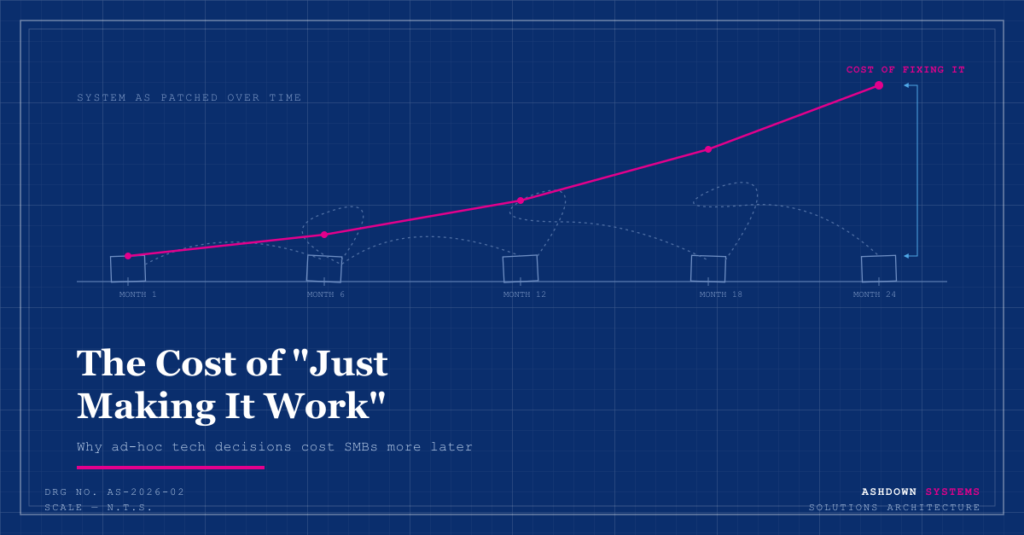
Waiting for the “right time” to sort this out is usually a way of guaranteeing the fix happens under the most pressure, with the least time, and at the highest cost. Technical debt, like financial debt, accrues interest. The businesses that deal with it early pay a small, manageable amount. The businesses that wait pay considerably more — in emergency fixes, lost time, and often a painful stretch where the tech genuinely can’t keep up with demand.
It doesn’t require starting over
The fix isn’t “rip everything out and start again” — that’s rarely necessary and almost never proportionate for an SMB. It’s about someone stepping back periodically to look at the whole system, not just the individual pieces:
- Which tools are actually doing the same job, or fighting each other?
- Where is data being copied by hand that should just flow?
- What’s one person away from breaking, with no backup plan?
- If we grew 3x tomorrow, what would fall over first?
Answering those questions properly — and building a plan around the answers — is exactly what Solutions Architecture is for. It’s not about buying more technology. Often it’s about using what you’ve already got, connected properly, with a plan for what gets added next.
The businesses that build this habit in early don’t eliminate the cost of growth. They just pay it steadily, in small amounts, instead of all at once, at the worst possible moment.
Ashdown Systems helps UK startups and SMBs untangle ad-hoc systems and build a foundation that can actually scale. If any of this sounds familiar, get in touch.